Takedown cost calculator: 1 to 100 a month
Ask a brand protection company what a takedown costs and you will usually be asked to book a call. We went through the category on 18 September 2026 and opened every pricing page. Two of us publish a number.
Nine companies price the job of closing storefronts that use your brand. Brand Protector is $199 a month for unlimited takedowns. Katcher is $99.99 a month plus $150 a takedown on Monitor, or $599 flat for unlimited on Defend. nebty charges $119 a month plus $340 per takedown. DMCA.com charges $199 a notice. The enterprise platforms run $1,250 to $3,834 a month.
What a month of takedowns costs
Seventeen companies. Every one appears, priced or not, because a company missing from a comparison reads as one nobody checked. The Katcher row is priced on whichever of our tiers is cheapest at that volume, and it is still not the cheapest row in the table.
| Option | 1 | 2 | 5 | 10 | 25 | 50 | 100 |
|---|---|---|---|---|---|---|---|
| KatcherStorefronts using your brand, by the no-signature routes we send and chase | $249.99 | $399.99 | $599 | $599 | $599 | $599 | $599 |
| nebtyMonitoring plus takedowns. Lookalike domains, fake websites, phishing, fake profiles and ads | $459 | $799 | $1,819 | $3,519 | $8,619 | $17,119 | $34,119 |
| Red PointsrepSelf-serve entry. Counterfeits, fake websites and domain abuse, by scope you buy | $1,250 | $1,250 | $1,250 | $1,250 | $1,250 | $1,250 | $1,250 |
| ZeroFoxrepMedian contract, whole platform. Domains, social accounts, executive impersonation, dark web | $3,800 | $3,800 | $3,800 | $3,800 | $3,800 | $3,800 | $3,800 |
| BolsterrepMedian contract, whole platform. Phishing, fake sites and fraudulent domains, at platform scope | $3,125 | $3,125 | $3,125 | $3,125 | $3,125 | $3,125 | $3,125 |
| BrandShieldrepAverage customer, derived. Counterfeits, phishing and executive impersonation | $3,834 | $3,834 | $3,834 | $3,834 | $3,834 | $3,834 | $3,834 |
| MarqVisionFocused program, their own guide. Counterfeits across marketplaces and social | $2,000 | $2,000 | $2,000 | $2,000 | $2,000 | $2,000 | $2,000 |
| Brand ProtectorMonthly. Counterfeit listings, lookalike domains, unauthorised sellers | $199 | $199 | $199 | $199 | $199 | $199 | $199 |
| DMCA.comFull Service, Standard. Anything by copyright notice, filed as your agent | $199 | $398 | $995 | $1,790 | $4,475 | $8,250 | n/a |
| DMCA.comDIY Takedown. The same notices, except you write, send and chase each one | $10 | $10 | $10 | $10 | $10 | $10 | $10 |
n/a is DMCA.com's published table running out at 50 notices a month. We do not extrapolate a named company's prices past what they will say in public.
| Company | Cheapest plan | What it removes | A month |
|---|---|---|---|
| BranditScan | Premium | Leaked creator content, 3 stagenames. Not storefronts | $69 |
| Ceartas | Star, per creator | Leaked content and Google delisting, per creator. Not storefronts | $69 |
| Onsist | Lite Protection | Pirated copies of your content, 1 keyword, plus VAT. Not storefronts | $199 |
| Rultarep | Legend | Leaked creator content, per username, plus VAT. Not storefronts | $324 |
| DMCA Masters | Basic | Leaked content and impersonator accounts, 1 product. Not storefronts | $89 |
Where each figure came from
Everything without a mark was read from the company's own pricing page on 18 September 2026. Rows marked REP are reported secondhand, from at least two independent write ups that agree on the figure, because the company either publishes nothing or refused our request. Treat those as good information rather than as the company's word, and tell us if one is wrong. Every figure with a note behind it is listed below, marked or not.
- Red Points. Base plan $938 a month, and a self-serve checkout that will not accept an order under $1,250 a month. Reported by knockoff.co (read 26 August 2026) and nebty-id.com (verified July 2026), which agree. Not confirmed on Red Points' own page.
- ZeroFox. Median buyer pays $45,604 a year, from data on 38 purchases (Vendr, read 18 September 2026). Shown here divided by twelve. It buys the whole digital risk platform, not a number of takedowns.
- Bolster. Median buyer pays $37,500 a year (Vendr, read 18 September 2026). Shown divided by twelve. Their own pricing address is a 404, and a separate write-up puts them at $4,000 to $12,000 a month, which this does not match.
- BrandShield. Derived, not quoted: their own FY2022 results give $8.42m of ARR across 183 customers, which is $46,010 a customer a year, shown here divided by twelve. It is an average across every size of client, and it is four years old. They publish no price and their pricing page refused our request.
- MarqVision. From their own buyer's guide: focused programs with a limited scope often fall below $2,000 a month, growth-stage programs run $25,000 to $100,000 a year, and enterprise programs may exceed seven figures. The ceiling of the entry band is used here.
- Rulta. $324 a month plus VAT for the top tier, with unlimited manual takedown requests. Two independent write-ups agree on this figure. They disagree on the entry tier, so it is not shown.
| Company | How they charge | What we found |
|---|---|---|
| Bustem | Pay per confirmed takedown | No pricing page, and no current price anywhere. The one real figure is historical: their founder told Hampton that early clients paid $2,000 to $5,000 a month on a retainer, a model he then dropped. Their site now says no retainer, billed on confirmed results, without ever saying what a result costs. A listicle names a per takedown figure and no second source repeats it, so it is not used. |
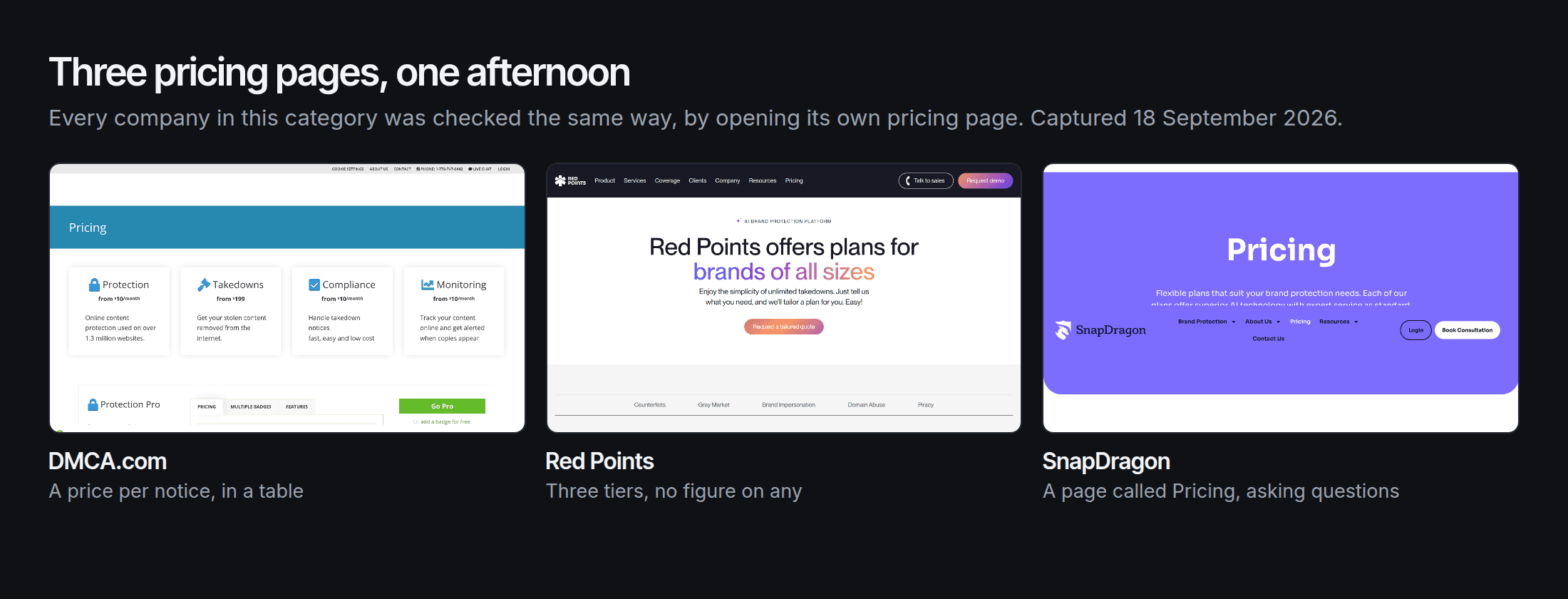
| SnapDragon | Quote questionnaire | They have a page called Pricing, and it is a questionnaire: pick the problems you have, then book a consultation. Three tiers are described by who they suit, with no figure against any of them. Their .com domain would not complete a TLS handshake with us either. |
| Doppel | Demo request only | No pricing page, a demo request form instead. No contract data on the procurement marketplaces, and no figure in any write-up we could find. |
Work out your own volume
Drag to the number of stores you are actually dealing with in a month. One is not a strange answer. Most brands arrive here with one.
Closing storefronts that use your brand
| Option | A month | Each |
|---|---|---|
| Katcher MonitorYour tierStorefronts using your brand, by the no-signature routes we send and chase$150 per standard takedown on top; your first one is included | $249.99 | $249.99 |
| Katcher DefendStorefronts using your brand, by the no-signature routes we send and chase | $599 | $599.00 |
| nebtyMonitoring plus takedowns. Lookalike domains, fake websites, phishing, fake profiles and ads | $459 | $459.00 |
| Red PointsrepSelf-serve entry. Counterfeits, fake websites and domain abuse, by scope you buy | $1,250 | $1250.00 |
| ZeroFoxrepMedian contract, whole platform. Domains, social accounts, executive impersonation, dark web | $3,800 | $3800.00 |
| BolsterrepMedian contract, whole platform. Phishing, fake sites and fraudulent domains, at platform scope | $3,125 | $3125.00 |
| BustemPay per confirmed takedown. Copycat sites and stolen product photography | Not published | Per takedown, amount unpublished |
| BrandShieldrepAverage customer, derived. Counterfeits, phishing and executive impersonation | $3,834 | $3834.00 |
| SnapDragonQuote questionnaire. Counterfeits, grey market, fake sites and social accounts | Not published | Annual contract |
| DoppelDemo request only. Social engineering, fake sites, impersonation | Not published | Annual contract |
| MarqVisionFocused program, their own guide. Counterfeits across marketplaces and social | $2,000 | $2000.00 |
| Brand ProtectorMonthly. Counterfeit listings, lookalike domains, unauthorised sellers | $199 | $199.00 |
| DMCA.comFull Service, Standard. Anything by copyright notice, filed as your agent | $199 | $199.00 |
| DMCA.comDIY Takedown. The same notices, except you write, send and chase each one | $10 | $10.00 |
Content and likeness, for comparison only
These are the only other companies in takedown that publish a price. They are flat monthly plans, so the slider does not move them, and none of them closes a storefront. They are priced per stagename, keyword or creator. Read this as the shape of transparent pricing in this industry, not as an alternative to the table above.
| Option | A month | Each |
|---|---|---|
| BranditScanPremium. Leaked creator content, 3 stagenames. Not storefronts | $69 | $69.00 |
| CeartasStar, per creator. Leaked content and Google delisting, per creator. Not storefronts | $69 | $69.00 |
| OnsistLite Protection. Pirated copies of your content, 1 keyword, plus VAT. Not storefronts | $199 | $199.00 |
| RultarepLegend. Leaked creator content, per username, plus VAT. Not storefronts | $324 | $324.00 |
| DMCA MastersBasic. Leaked content and impersonator accounts, 1 product. Not storefronts | $89 | $89.00 |
At 1 a month you should be on Katcher Monitor, at $249.99.
Unmarked figures were read from the company's own pricing page on 18 September 2026. REP is reported secondhand from two independent write ups that agree, because the company publishes nothing or refused our request. Sources are listed under the table above.
Scan my brand, freeWho publishes a price, and who does not
We loaded the pricing page of every company we could find in this business, then went looking elsewhere for the ones that publish nothing. Fourteen have a number we could stand behind. Three do not, and they are in the tables anyway with what we found when we looked.
The cheapest real option here is not ours. Brand Protector charges $199 a month, flat, for unlimited takedowns across counterfeit listings, lookalike domains and unauthorised sellers. Above about two takedowns a month it is cheaper than anything else in the table, ours included. Their model is detection plus drafting and filing at a fixed price, with no per takedown fee at all.
The closest thing to a like for like competitor is nebty, and they publish everything: $119 a month for monitoring one brand, then $340 for each takedown that succeeds, or $450 without the monitoring. Same job as ours, same category of target, and no success no fee. At five stores a month that is $1,819 against our $599, and at one store it is $459 against our $249.99 on Monitor. nebty's appeal is the model rather than the price: you pay per successful takedown, so you carry no monthly fee in a quiet month.
Red Points is the one number here we did not read ourselves. Their pricing page carries three tiers and not one figure. The self serve checkout that does carry figures is a five step JavaScript wizard we could not read, so the $938 base and the $1,250 monthly minimum come from two independent write ups that agree with each other. It is marked as reported in the tables, and if it is wrong we would like to be told.
Most of the transparent pricing is not in storefront takedown at all. It is in content and likeness protection, where someone is having leaked photos and impersonator accounts removed for a named person. Those plans are flat and start at $69 a month. At fifty takedowns they look an order of magnitude cheaper than anything else on this page, and not one of them closes a storefront. They are in their own table for that reason.
Two of the enterprise platforms have real numbers, from purchase data rather than a price list. Vendr, which brokers software contracts, publishes what its buyers actually paid: a median of $45,604 a year for ZeroFox across 38 purchases, and $37,500 a year for Bolster. Those buy an entire digital risk platform rather than a number of takedowns, so read them as what this category costs at enterprise scale, not as a per store price.
BrandShield does not publish a price, but it does publish accounts. It is listed on AIM, and its FY2022 results give $8.42m of annual recurring revenue across 183 customers. That is $46,010 a customer a year, or $3,834 a month. It is an average across every size of client and it is four years old, so treat it as an order of magnitude rather than a quote. It is also the only figure on this page we worked out ourselves rather than read.
MarqVision publishes bands, just not on its pricing page. Its own buyer’s guide says focused programs with a limited scope often fall below $2,000 a month, growth stage programs run $25,000 to $100,000 a year, and enterprise programs may exceed seven figures. That is more candour about real contract sizes than anyone else at that end of the market offers.
Three still have no usable price: Bustem, Doppel and SnapDragon. Bustem is the interesting one. Its founder told an interviewer that early clients paid $2,000 to $5,000 a month on a retainer, then said he dropped that model entirely. The site now says no retainer, billed on confirmed results, the same success based shape nebty uses, without ever saying what a result costs. Doppel has nothing anywhere, including the procurement marketplaces. SnapDragon has a page called Pricing, and it is a questionnaire: pick your problems, then book a consultation.
We went through the category vendor by vendor in brand protection pricing, who publishes a price.
The two priced options are not the same job
They answer the same question, which is what a month of this costs. They do not do the same thing, and the difference decides which one you can use.
DMCA.com files a copyright notice for you, as your agent. That notice carries a statement, under penalty of perjury, that the use is not authorised.
Katcher starts somewhere else. Most of what closes a store needs no signature and no rights holder at all: browser safety flags, the host's abuse desk, the registrar under its own published policy, the CDN and the payment processor. Those describe what a site is doing. They assert nothing about who owns what, and they are what Monitor and Defend buy.
The sworn routes are a separate line. On Monitor and Defend we prepare a copyright or trademark notice from the evidence and you send it from your own address, because only you can swear that statement. On Managed and Enterprise, where a domain dispute is the right route and the authority to act is in place, we file the URS or UDRP as your designated agent. Either way the statement is made by someone entitled to make it.
We cannot know who you have authorised. Your contracts and your sales team know that, and nobody outside your company does.
Which plan at which volume
Our pricing is not per close. You buy a level of handling, and the agent takedowns come with it.
- Monitor, $99.99 a month (launch price): one brand with weekly checks and alerts, your first standard takedown included, then $150 for each one after. The entry point when you have a store or two to deal with.
- Defend, $599 a month: one brand, unlimited agent takedowns, pre-authorised so they go the moment the evidence is in. At three stores a month or thirty, it is the same $599, which is why the row is flat.
- Managed, $1,500 a month: unlimited and done for you, we chase each one, and where a URS or UDRP is the right route we file it as your designated agent once the authority is in place. A $750 setup, waived on an annual plan.
- Enterprise, $2,500 a month: the same handling across up to five brands, then $400 a month for each brand beyond.
URS and UDRP domain disputes are priced per action on top, from $1,000, because they are occasional and expensive rather than a monthly volume. The full ladder, with those legal fees against each plan, is in brand protection pricing.
What these numbers leave out
Every option here has a real limitation, ours included.
- Katcher. Monitor prices each takedown at $150 after the first, and from four a month Defend's flat fee is cheaper, so the cost per store falls as volume rises rather than climbing. What none of it buys is permanence: a store that comes down can reappear on a new domain for the cost of the domain, and then it is another takedown.
- DMCA.com managed. The published table stops at 50 notices a month, so above that there is nothing to compare. The Standard column is the one in the table; their Premium and Platinum columns cost roughly two and three times as much.
- DMCA.com DIY at $10. Unlimited notices, but you write each one, send it and chase it. The money is not the cost here. Your afternoon is.
- The creator services. Genuinely cheap and genuinely transparent, and they solve a different problem. Their limit is how many stagenames or products you cover, not how many takedowns you file.
- nebty. Priced per successful takedown with no monthly commitment beyond monitoring, so you carry no fee in a quiet month. The trade is the unit price: at $340 a takedown it passes our flat $599 at two a month and keeps climbing.
- ZeroFox, Bolster and BrandShield. Those are annual contracts for a whole platform divided by twelve, and BrandShield's is an average worked out from its accounts. Dividing a contract by twelve does not turn it into a takedown price, and none of the three sells one.
- The three with no price. They may well be cheaper than all of us. We have no way to know, and neither do you until you have taken the call.
Frequently asked questions
How much does one takedown cost?
On Katcher, Monitor is $99.99 a month plus $150 a takedown after your first, which is included, and Defend is $599 for unlimited, so the more you have the less each one costs. nebty charges $340 plus monitoring per successful takedown, DMCA.com $199 for a managed copyright notice, and below all of those $10 a month buys unlimited DIY notices you write and chase yourself.
Is a subscription cheaper than paying per takedown?
For anything recurring, yes. Monitor is $99.99 a month plus $150 a takedown and Defend is $599 for unlimited, so against nebty's $119 plus $340 a takedown Katcher costs less from the first store, and from four a month Defend's flat fee keeps widening the gap. Paying per takedown only wins if you truly have a single store and will never see another.
Why do brand protection companies hide their pricing?
Most of the category sells to enterprise legal and brand teams on annual contracts, where price depends on how many brands, marketplaces and countries are in scope. That is a real reason. It is still an obstacle if you are one brand with three fake stores. Note where the transparent pricing does exist: creator content protection, selling to individuals who will simply leave if the price is hidden.
Does a closed store stay closed?
Often not. A storefront is cheap to rebuild on a new domain, and the same operator frequently reappears within weeks. Treat takedowns as a recurring cost, which is why this page is priced per month rather than per incident.
Do I need a lawyer to get a fake store taken down?
Not for the routes that need no signature, which are the ones that close most stores: browser safety, the host, the registrar, the CDN and the payment processor. A copyright or trademark notice is different, because it carries a sworn statement that only the rights holder, or an agent they have formally authorised, can make.
What does a free scan actually give me?
The list of storefronts using your brand, and for each one the evidence behind it with instructions to check it yourself in about a minute. No card and no sales call. Closing anything is a separate decision and a separate price.
If you do not know your own number yet, start by finding out how many there are. The scan is free and takes one brand at a time.
Questions
How much does one takedown cost?
On Katcher, Monitor is $99.99 a month plus $150 a takedown after your first, which is included, and Defend is $599 for unlimited, so the more you have the less each costs. nebty charges $340 plus monitoring per successful takedown and DMCA.com $199 for a managed copyright notice. Below those, $10 a month buys unlimited DIY notices you write and chase yourself.
Is a subscription cheaper than paying per takedown?
For anything recurring, yes. Monitor is $99.99 a month plus $150 a takedown and Defend is $599 for unlimited, so against nebty's $119 plus $340 a takedown Katcher costs less from the first store. Paying per takedown only wins if you have a single store and never expect another.
Why do brand protection companies hide their pricing?
Most of the category sells to enterprise legal teams on annual contracts scoped by brands, marketplaces and countries. That is a real reason, and still an obstacle if you are one brand with three fake stores.
Does a closed store stay closed?
Often not. A storefront is cheap to rebuild on a new domain and the same operator frequently reappears within weeks. Treat takedowns as a recurring monthly cost rather than a one off.
Do I need a lawyer to get a fake store taken down?
Not for the routes that need no signature: browser safety, the host, the registrar, the CDN and the payment processor. A copyright or trademark notice is different, because it carries a sworn statement that only the rights holder, or an agent they have formally authorised, can make.